 RobotBoxe
This production guide is part of our robot fighting culture coverage.
The four main ingredients
The film’s believable robots came from a coordinated production pipeline rather than a choice between “practical” and “computer-generated.”
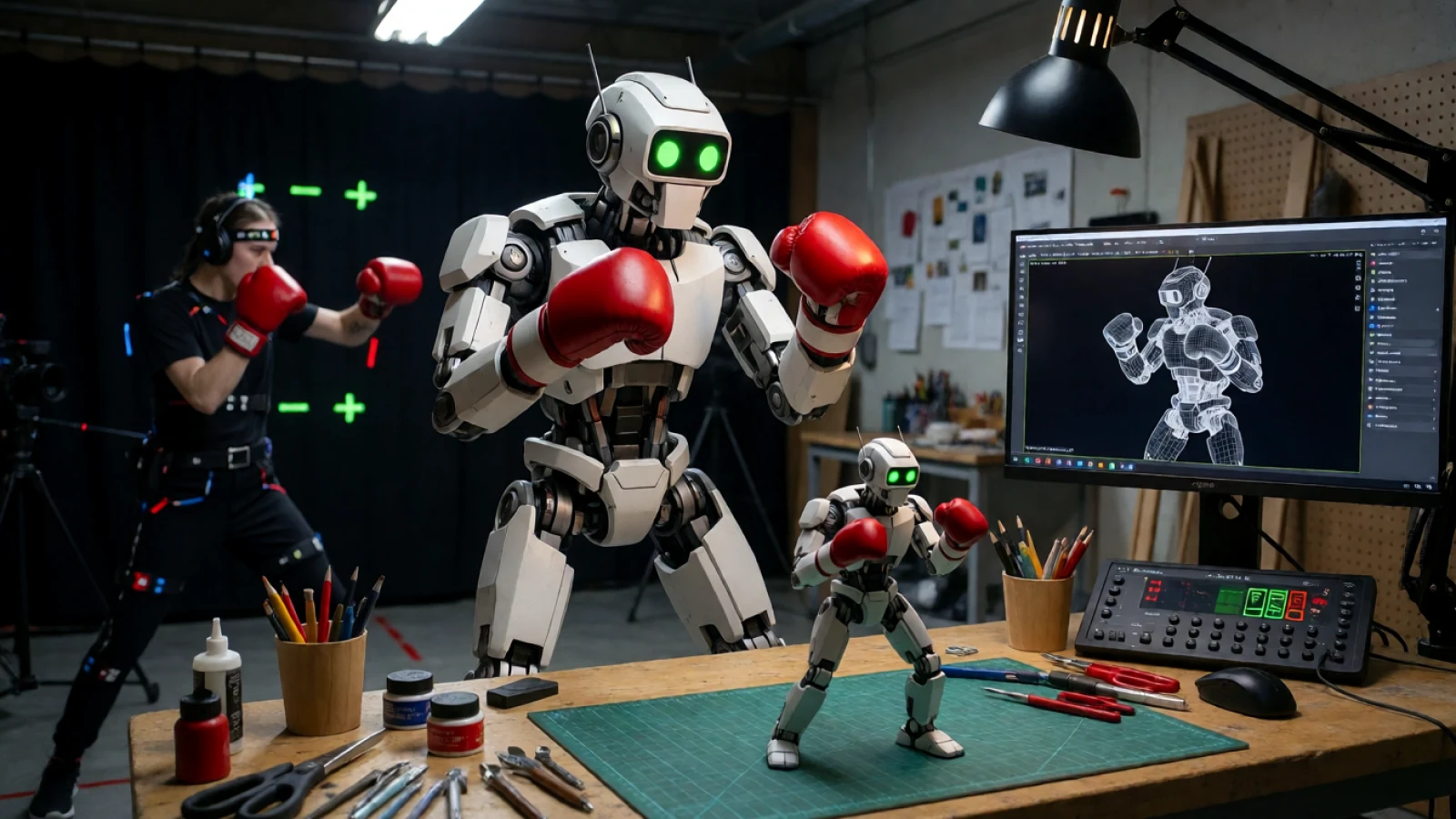
| Technique | What it contributed | |---|---| | 3D-printed scale models | Faster design review, painting, lighting and approval before full-size production | | Full-size animatronic robots | Physical presence, human contact, close-up detail and lighting reference | | Motion capture | Human boxing performances and distinct movement personalities for digital robots | | CGI and virtual production | Complete fight choreography, digital environments, damage and integration into live-action footage |
The most important word is combined. A practical Atom could appear in one kind of shot, while a digital Atom performed a fight movement in another. Consistent design, lighting and animation helped hide the transitions.
Step 1: designing robots that could exist in both worlds
Legacy Effects and Digital Domain worked with the production art department so that the practical and digital versions would share believable designs and mechanics.
That coordination mattered because a robot built only as a physical prop might have shapes or joints that were difficult to reproduce digitally. Conversely, a digital design that ignored physical construction could make an animatronic version look noticeably different.
The teams treated the robot as one character asset with two production forms. Surface detail, silhouette, body mechanics and movement had to remain coherent when a scene moved between them.
Step 2: 3D printing the one-fifth-scale models
Legacy Effects used an Objet 3D printer to produce one-fifth-scale models. Once those models were built, hand-painted, lit and approved, the full-scale Atom, Noisy Boy and Ambush robots went into production.
The small models offered a fast way to inspect a design as a physical object rather than only on a monitor. Artists could evaluate surface detail, paint and light before committing to the cost and time of full-size construction.
This does not mean the movie simply printed entire autonomous fighting robots. The printers were used in the design and fabrication workflow; the finished film characters still required practical-effects construction and digital animation.
Step 3: building full-size animatronic robots
Legacy Effects built practical versions of Atom, Noisy Boy and Ambush. Visual-effects supervisor Erik Nash explained in an Art of VFX interview that these robots were used extensively for shots involving human contact and upper-body animation.
Practical robots provided several advantages:
- actors could physically interact with a real object;
- the camera recorded actual reflections, shadows and surface wear;
- directors could stage close shots without replacing every pixel;
- digital artists gained a tangible lighting and texture reference.
The physical builds were not expected to perform every boxing move. Their value lay in making the robots occupy the same material world as the actors.
Step 4: creating the digital fighting lineup
Digital Domain modeled, textured and rigged eight principal digital robots for the fights: Ambush, Noisy Boy, Midas, Atom, Metro, Blacktop, Twin Cities and Zeus, along with background machines.
CGI made actions possible that would be impractical or unsafe for a full-size prop: rapid combinations, full-body impacts, falls, structural damage and complex arena choreography.
Digital doubles also allowed the production to maintain a consistent character while adjusting the demands of each shot. The audience sees “Atom”; the production chooses the practical or digital version best suited to the moment.
Step 5: capturing human fighting performances
The fights were not created only by asking animators to invent every movement from nothing. Motion-capture performers supplied the physical foundation.
According to Nash, different performers were assigned to different robots. That gave each character a distinct physical personality rather than making every machine move with an identical generic style.
Motion capture is not the same as simply copying a person’s silhouette onto metal. The data becomes part of an animation pipeline. Artists can refine timing, contacts, mechanical behavior and effects while preserving the useful rhythm and weight of a performed exchange.
This is also why the film’s “shadow mode” should not be confused with the production method. Shadow mode is a story interface; motion capture is one of the techniques used to create the movie itself.
Step 6: seeing digital robots during live-action shooting
Digital Domain describes a virtual-production workflow that allowed Levy to direct computer-generated characters as if they were present in the ring.
Fight action was planned and captured before the live-action location work. Digital characters and matching virtual environments were then used with a Simul-Cam approach during principal photography in Detroit.
Through a monitor, the director and camera team could see a composite of the digital robots within the real location. That allowed camera movement and framing to respond to the fight instead of treating the empty ring as an unrelated background to be fixed later.
The result was a more organic visual language: pans, framing and camera timing could follow action that had already been choreographed, even though the final digital robots would be completed in post-production.
Why practical and digital shots blend so effectively
The transition works because each method supports the other.
Physical reference improves the CGI
The Legacy robots gave Digital Domain real materials, wear and lighting behavior to study. Artists did not have to imagine how every scratched metal surface should react under arena lights.
Matching rigs improves the animation pipeline
Nash explained that coordination between Digital Domain and Giant Studios produced compatible skeletons and naming conventions. That reduced unnecessary retargeting when motion-capture data moved into the final digital-character workflow.
Shot selection plays to each method’s strength
Practical robots handle presence and contact. Digital robots handle full-body choreography and damage. Editing combines them around the story rather than forcing one technique to solve every problem.
Were the Real Steel robots real machines?
Some were real physical props, but they were not autonomous boxing robots in the modern engineering sense. The animatronics could be operated for designed shots, while the full fighting characters were digital creations driven by performance capture and animation.
That distinction is useful when comparing the film with URKL. A modern T800 must actually balance, sense contact and execute motion with its own hardware. The film could choose whichever production technique made a shot convincing.
Our Real Steel vs. URKL guide compares those filmmaking freedoms with present-day robot constraints.
What modern robot boxing can—and cannot—borrow from the film
Live events can borrow presentation ideas: distinctive armor, fighter names, dramatic entrances and clear visual identities. They can also use motion capture during development to create or retarget movement references.
They cannot borrow the freedom to replace a difficult physical moment with a digital double. In a real bout, the machine must complete the action or fall. There is no post-production compositing pass inside the arena.
That is why the film remains both an inspiration and an unfair benchmark. Its robot effects were designed to tell a story flawlessly; real robots are designed to function under physical uncertainty. For the separate question of whether the franchise will return, read our Real Steel 2 and Disney+ series status guide.
For the broader cultural path, read From Real Steel to Shenzhen. For a modern filmmaking proposal, see whether the T800 could become a movie stunt robot.