 RobotBoxe
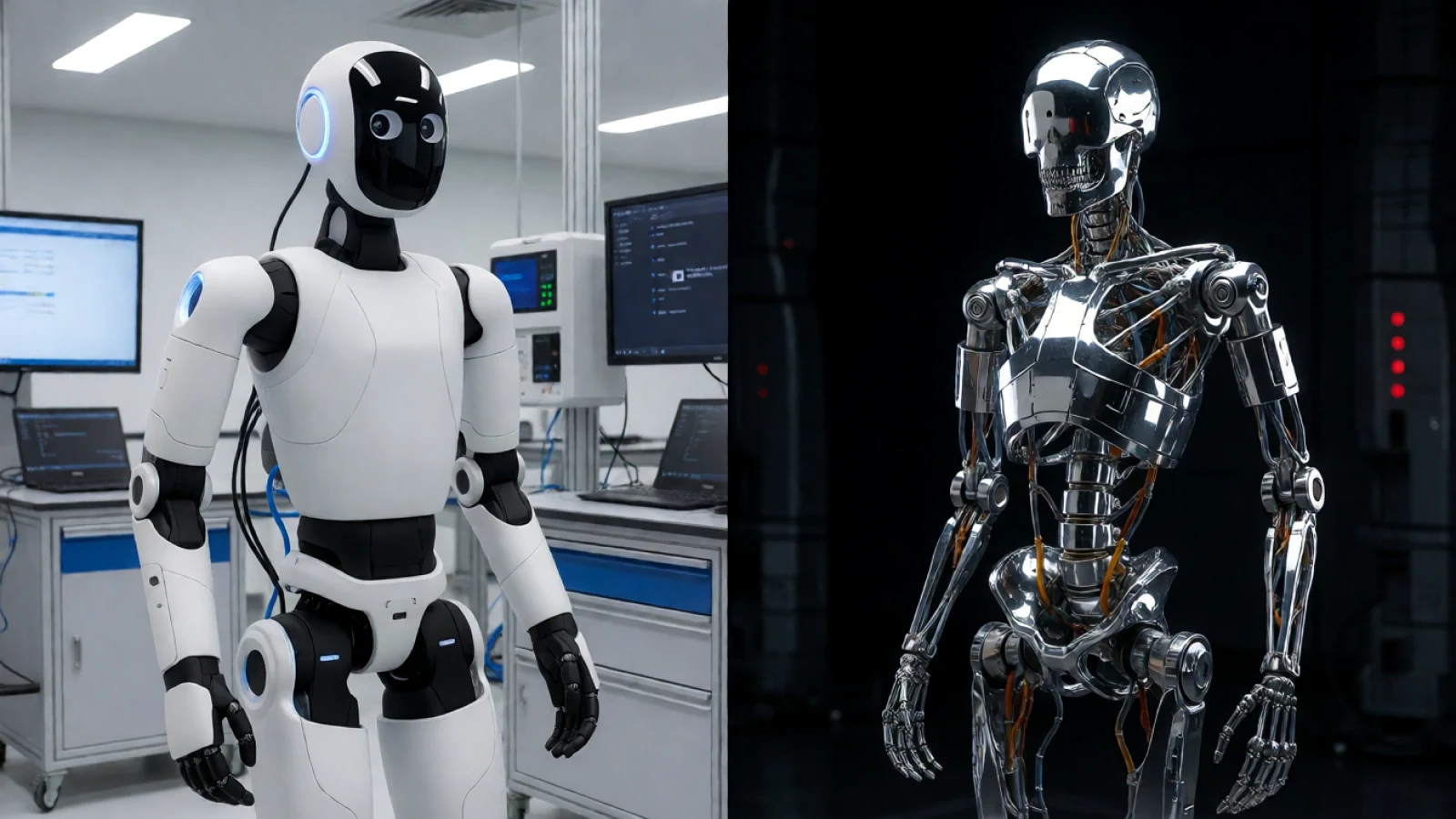
This comparison is part of our robot fighting culture coverage.
Are the two T800s the same thing?
No. They share a memorable name and a humanoid silhouette, but they belong to completely different categories.
| Feature | EngineAI T800 | Terminator T-800 | |---|---|---| | Category | Physical humanoid robot platform | Fictional cybernetic assassin/protector character and machine | | Origin | EngineAI, Shenzhen | The Terminator film franchise | | Published height | 173 cm | Not a specification shared with the real robot | | Construction | Aviation aluminum and titanium listed by EngineAI | Fictional hyper-alloy combat chassis with living tissue in the film concept | | Intelligence | Real software, sensors and control configurations | Fictional advanced AI associated with Skynet | | Public purpose | General-purpose robotics, development and documented combat-event use | Fictional infiltration, combat and character-driven missions | | Control | Depends on deployment; URKL rules allow remote, teleoperated and autonomous strategies | Determined by the film’s story | | Franchise relationship | No official licensing relationship established by the cited sources | Original fictional property |
The punctuation also varies. EngineAI’s product page uses T800, while the film character is commonly written T-800. That typographical difference is useful in an explainer but is not, by itself, a legal or technical distinction.
Why is EngineAI’s robot called T800?
A July 2025 report by robotics writer Mike Kalil described the prototype name as a nod to the iconic Terminator robot, citing a Shenzhen television interview with EngineAI founder Zhao Tongyang.
That supports a cultural-inspiration explanation. It does not prove that:
- EngineAI licensed the Terminator name or character;
- the film studio endorses the robot;
- the machine was built to replicate every movie capability;
- the robot is a prop or official franchise merchandise.
Unless EngineAI or the relevant rights holder publishes such a relationship, the accurate wording is “widely described as Terminator-inspired,” not “the official Terminator robot.”
The real T800: what EngineAI actually publishes
EngineAI lists the T800 at 173 cm tall and 75–85 kg, depending on configuration. Its commercial range includes Basic, Open Source, Pro and Max editions with different joint totals, sensing and computing options.
Published highlights include:
- maximum joint torque of up to 450 N·m;
- hardware-supported moving speed of ≥2 m/s;
- product-table battery life of 3–5 hours;
- binocular vision, with 3D LiDAR listed on versions above Basic;
- aviation aluminum and titanium structural materials;
- active air-cooling features;
- secondary development on Open Source, Pro and Max editions.
These figures are manufacturer specifications with configuration and operating-condition caveats. They are not measurements taken from the fictional Terminator and should not be inflated into claims of invulnerability or unrestricted strength.
Our T800 movie stunt-robot analysis examines a separate proposed entertainment use without treating it as a completed film role.
The movie T-800: why the comparison feels natural
The original Terminator concept combines a durable machine endoskeleton with a human-like exterior. It walks, fights, pursues objectives and appears physically capable in ways that made the character an enduring visual reference for real humanoid robotics.
When a real company gives a full-size metal humanoid the name T800, audiences immediately connect the two. The comparison communicates “human-shaped machine with presence” in a single word.
But film robots are designed around narrative needs. A director can show exactly the movement, damage or recovery required by a scene. A real engineering team must make every action work with batteries, motors, sensors, contact physics and finite control reliability.
Strength: movie power versus joint specifications
The fictional T-800 performs feats written for cinema. The real T800 publishes a maximum joint torque figure of up to 450 N·m.
Torque is a rotational measurement at a joint. It is not the same as:
- punching force in newtons;
- the robot’s total lifting ability;
- continuous output at every joint;
- destructive power;
- the ability to throw a person or vehicle.
EngineAI also warns that parameters vary with scenario, posture and real conditions. A responsible comparison therefore avoids assigning a movie-inspired “strength level” to the hardware.
Intelligence: deployed software is not Skynet
The real T800 can run perception, planning and control software, and developer editions provide computing options. That is still far removed from the fictional idea of a machine with a broad autonomous mission, human-like strategic understanding and a franchise-wide AI network.
A robot may autonomously select a prepared boxing action without being conscious or generally intelligent. It may also balance autonomously while a human operator chooses when to strike.
The useful question is not “Is it as smart as the Terminator?” but which decisions does this deployed system make, using which sensors and under what supervision?
Our guide to how robot fighting works breaks down the control methods used in competition.
Appearance: armor does not make a movie character
EngineAI’s dark, angular humanoid designs make the cinematic comparison visually effective. Public URKL fighter identities add another layer through names, colored armor and arena presentation.
That styling is part of communication and entertainment. It does not turn the underlying machine into a fictional character with motives. White Eagle or Matador can be a memorable fight identity while remaining a physical robot operated under an event-specific technical configuration.
Similarly, a scripted movie shot and a produced live-event entrance can both be theatrical without making the physical robot itself unreal.
Can the real T800 do what the Terminator does?
No general equivalence should be assumed. The real robot has demonstrated dynamic movements and physical combat-event sequences, but it still operates within published hardware limits and real-world reliability constraints.
It is not documented as having:
- living human tissue;
- self-repair after arbitrary catastrophic damage;
- unlimited endurance;
- human-level understanding across unrestricted environments;
- the film character’s full combat capabilities;
- immunity to falls, impacts or component failure.
Those absences are not embarrassing. They simply mark the boundary between a 1980s science-fiction concept and a 2020s engineering platform.
Why the comparison is still useful
The Terminator comparison can introduce real robotics to a broad audience—as long as it leads to better questions rather than bigger exaggerations.
It lets us ask:
- What makes upright balance difficult?
- How does a robot perceive an opponent?
- Who chooses a punch?
- What happens when a joint overheats or a battery runs down?
- Why can a robot perform one impressive move but struggle with an unexpected disturbance?
Those questions reveal why current humanoids are interesting without pretending that fiction has already been achieved.
For more on the movie connection, see Real Steel vs. URKL and our guide to how Real Steel made its robots.