 RobotBoxe
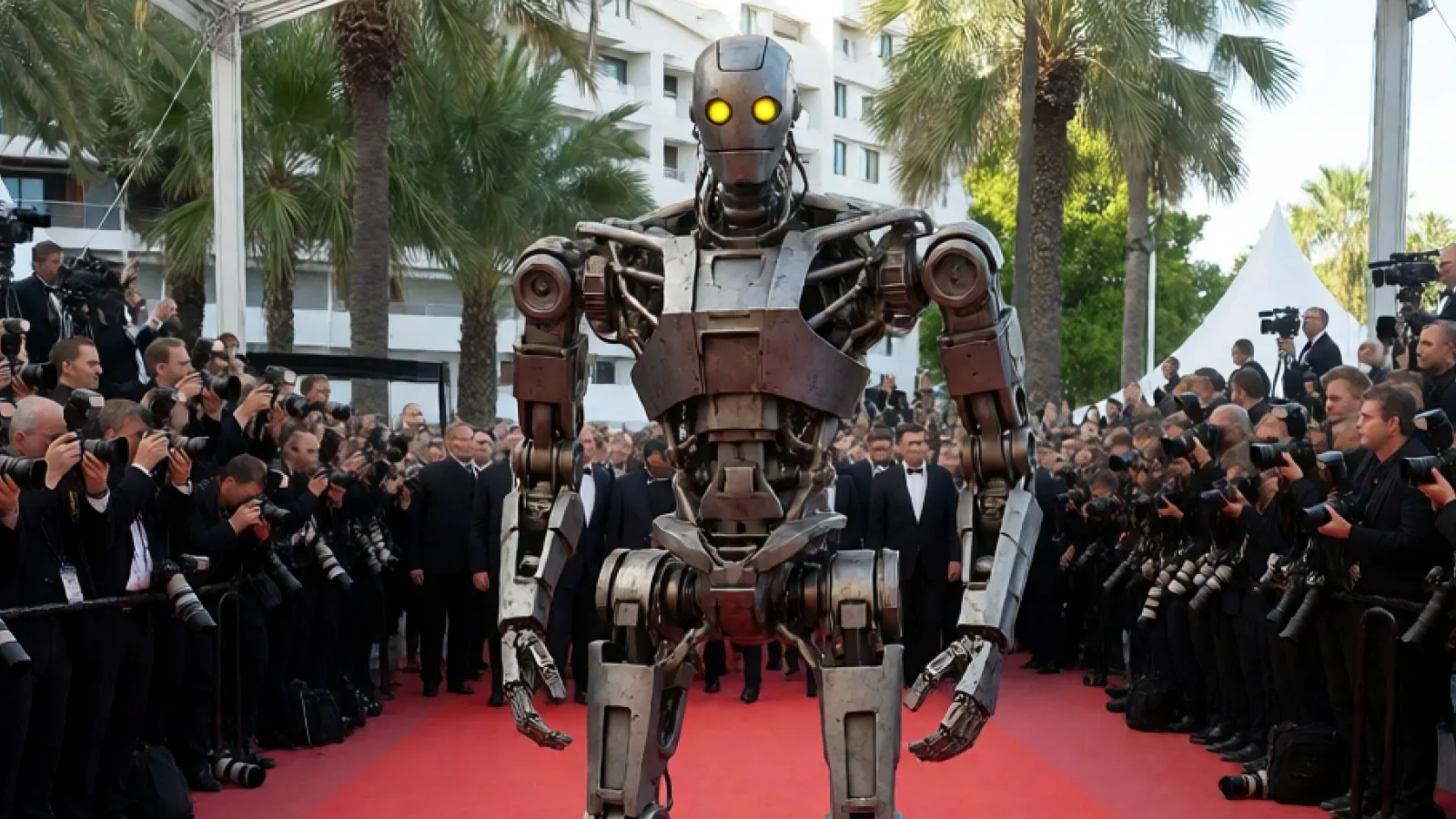
This story sits at the intersection of filmmaking and robot fighting culture.
What Moskino actually announced
Moskino’s documentary about people and machines examines how robotics, stunt work and digital characters might contribute to film production. One example is the EngineAI T800 introduced during the Robot Show at the Moskino Film Factory.
The accompanying report says the Moskino team plans to prepare the T800 for filmmaking. It discusses tasks for which accurate, repeatable movements are valuable, while acknowledging that other uses remain experimental.
That wording matters. Moskino has not announced that the robot has completed a professional stunt shoot, replaced a stunt performer or demonstrated a full acting performance. The announcement establishes an intention and a production experiment.
The report carrying this statement was published by Business Standard with a disclaimer that none of its journalists was involved in creating the content. It should therefore be treated as Moskino-provided material rather than independent validation. Separately, Moscow 24 documented the October 7 Robot Show and confirms that nine humanoids—including Unitree, AgiBot and EngineAI T800 models—performed synchronized martial-arts elements alongside performers.
What happened at the Moscow Robot Show
Moscow 24’s account describes three connected areas at the event:
- Physical and digital robot combat. Heavy machines operated by development teams fought on a real arena while a digital contest appeared on a large screen.
- Live motion capture. Two actors in motion-capture suits demonstrated fighting techniques, which digital robot avatars repeated in real time on a virtual Moscow rooftop.
- Human–humanoid performance. Nine humanoid robots performed synchronized martial-arts movements beside artists wearing kimonos.
This combination is more relevant to cinema than a simple robot demonstration. It brought together physical action, captured human movement, digital characters and a live audience—the same broad ingredients used in contemporary effects production.
The event does not prove that every shown technology was integrated into one filmmaking workflow. It does show why a film organization would investigate the overlap.
Why a humanoid robot could be useful on set
Repeatable physical action
A stunt may need to be repeated for another camera angle, a lighting adjustment or a cleaner take. Human performers train for repeatability, but fatigue and small variations still accumulate.
A robot could, in principle, replay a precisely defined movement with consistent timing. That would be useful for matching plates, coordinating camera movement or aligning a physical action with digital elements.
“Repeatable” does not mean effortless. Contact with props, uneven surfaces and other performers introduces variation, and every reset still requires inspection and technical preparation.
A physical presence in the shot
Computer-generated characters are flexible, but a physical machine can provide real contact with the floor, real shadows and real interaction with suitable props. Those elements can help a shot feel grounded.
A humanoid also gives the camera a body-shaped reference at the intended scale. Even if parts are later replaced or enhanced digitally, the practical element can support blocking, lighting and composition.
Separation of performer and hazardous action
Film crews already use remote devices, rigs, puppets and digital doubles to reduce exposure to danger. A programmable humanoid could become another option for selected actions, provided its own failure modes are controlled.
It would not make a set automatically safe. A heavy robot can fall, strike an unexpected object or move differently after damage. The safety case would need to address the machine, its power system and everyone nearby.
A bridge between live action and digital characters
Moskino’s documentary places robotics beside motion capture, computer graphics, game engines and virtual environments. That is a logical grouping: a physical robot and a digital double can share movement data, camera planning or a common action design.
A captured martial-arts sequence could inform an animated character. A robot might perform a simplified physical version on set. Visual-effects artists could then combine or extend those elements. The exact workflow would depend on the shot, not on a universal “robot actor” button.
What motion capture can—and cannot—do
The Robot Show’s live avatars make motion capture look direct: an actor moves and a robot character copies the action. For film production, that is only the beginning of the process.
A human performer’s recorded skeleton must be mapped to a character with different proportions. Feet may slide, contacts may not line up and physically impossible transitions may need correction. For a real humanoid, the challenges become stricter because the result must obey balance, actuator and collision constraints.
Motion capture is therefore best understood as a source of movement and performance intent. Retargeting, cleanup, physics and control turn that source into a usable robot or digital-character action.
This distinction also applies to the movie fantasy of instant shadowboxing. Our comparison of Real Steel and URKL explores why copying a boxer’s movement is not the same as producing a stable robot fight.
The T800’s relevant strengths
The T800, the platform used in URKL, is a full-size humanoid designed around dynamic whole-body movement. Its public demonstrations include walking, punches, kicks and recovery from falls. Those are relevant foundations for action choreography because they involve the whole body rather than a single robotic arm. For the hardware details behind those movements, Shenzhen Robot Combat maintains a technical profile of the EngineAI T800.
Its URKL appearances also show something valuable for fiction: the machine can make physical action readable. A guard, stagger or attempted recovery communicates an idea to an audience even before digital effects are added. Our history of robot fighting from Real Steel to Shenzhen traces how that spectacle developed.
For filmmaking, however, the relevant specification is not simply whether a robot can execute a spectacular move once. Production would need to know:
- how accurately the action can be repeated;
- how long setup and reset take;
- whether the timing can be adjusted to a camera or cue;
- how the robot behaves near people and props;
- how performance changes as temperature or battery state changes;
- which movements require a safety rig or digital cleanup.
Moskino’s public announcement does not answer those production questions yet.
The biggest limitations
Stunt work is more than executing a move
Professional stunt performance involves timing, spatial awareness, communication and adaptation to another performer. A choreographed fall may change because a camera moves or another actor is out of position.
A robot executing a fixed trajectory is not automatically capable of that responsive performance. Safe interaction would require tightly controlled choreography or additional sensing and control capabilities.
Falling safely is difficult
Human stunt performers learn how to distribute impact and protect vulnerable areas. A robot can be programmed to fall, but its rigid structure, actuators and battery create different risks. A fall that looks good on camera may still damage expensive hardware or the set.
Research into safer humanoid falls is active, but no public evidence establishes a film-ready safe-fall system for Moskino’s T800 project.
Acting requires more than athletics
A humanoid could plausibly supply a body for an action shot. Convincing character performance also depends on posture, timing, gaze, facial expression and subtle reactions. The T800’s human-shaped body does not solve those creative problems by itself.
A digital face, replacement shots or an entirely nonhuman character may be more practical than asking the machine to reproduce a human actor’s full performance.
Continuity and reliability matter
Film production rewards predictable reset times. Battery changes, overheating, calibration, repair and software issues can all interrupt a shooting day. A spectacular robot that works once may be less useful than a simpler effect that works twenty times on schedule.
This is why Moskino’s emphasis on repeatability is important—and why the plan still needs production evidence.
Would it replace human stunt performers?
The more plausible near-term role is collaboration. Performers and choreographers can design movement, motion-capture actors can supply reference action, and robots or digital doubles can handle selected visual elements.
A director still decides what the action means. A stunt coordinator still shapes the sequence and its safety. Visual-effects artists still integrate physical and digital material. The robot becomes another instrument inside that process.
Moskino’s own documentary framing keeps creative professionals at the center: the director determines the storytelling, the actor creates the action and the cinematographer decides how it is seen. Its proposed T800 work is better read as an expansion of that toolkit than as the disappearance of stunt professionals.
What would count as real progress?
The next meaningful announcement would not be another general claim that robots are the future of cinema. It would be a documented production test showing:
- a specific shot or action the T800 performed;
- the number and consistency of successful takes;
- the safety measures used around the machine;
- the amount of digital replacement or cleanup;
- the reset time and crew workflow;
- whether the result saved time, reduced risk or enabled a previously difficult shot.
Until such evidence appears, “Moskino is preparing a T800 for filmmaking” is accurate. “The T800 is already a proven robot stunt actor” is not.