 RobotBoxe
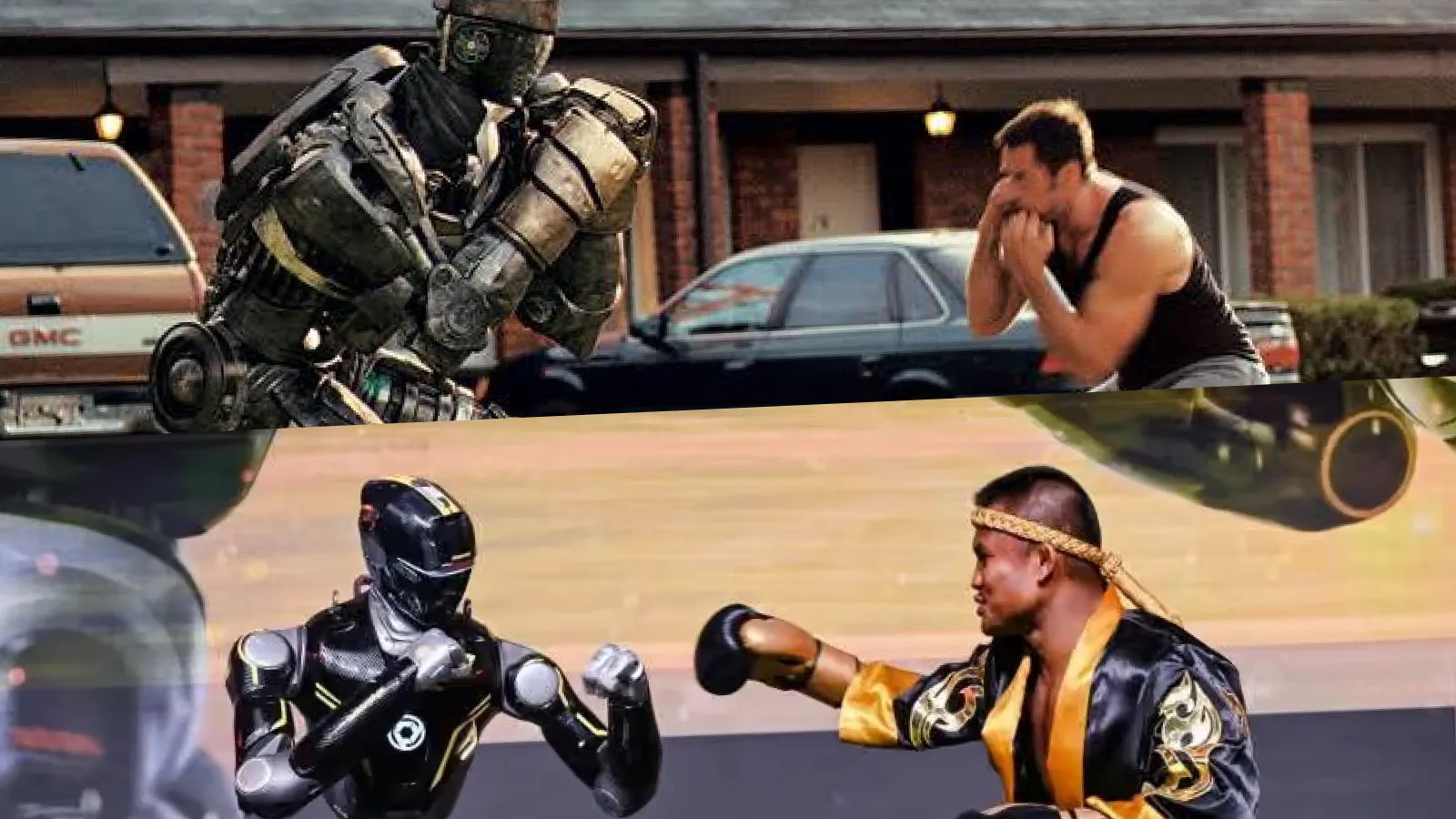
This comparison is part of our robot fighting culture coverage.
Why every URKL clip gets called “Real Steel in China”
The comparison is immediate because both properties use the same visual language. Two human-shaped fighters enter an arena, raise their guards and exchange strikes while an audience reacts. There are corners, teams, entrances and a narrative built around the machines.
That is very different from watching two low, wheeled machines attack each other with spinning weapons. The humanoid form lets viewers apply what they already know from boxing, kickboxing and MMA. A slipped punch, a compromised stance or a delayed recovery needs no specialist explanation.
URKL’s July 16, 2026 opening event in Shenzhen turned that familiar movie image into documented live entertainment. Its September Shanghai show added a kip-up, curved footwork, a flying knee and a multi-robot finale. For the road from earlier robot contests to that first Shenzhen event, read our history of how robot fighting went from Real Steel to Shenzhen. This article focuses on the comparison itself.
The movie’s basic setup
Released in 2011, Real Steel stars Hugh Jackman as Charlie Kenton, a former boxer struggling in a world where machines have replaced humans in the ring. Charlie and his son Max rebuild an older sparring robot called Atom, whose ability to mirror a person’s movements becomes central to its fighting identity.
Atom’s rise through increasingly important fights gives the film its sports-movie structure. The machines may do the punching, but people choose the tactics, repair the hardware and supply the emotional stakes.
That combination was the film’s sharpest prediction. The interesting contest was never just “which robot is stronger?” It was “which people can prepare, control and present their fighter most effectively?”
What Real Steel got right
1. Human-shaped robots make combat easy to read
Atom, Zeus and the film’s other fighters have heads, torsos, arms and legs. Their movement borrows from boxing, so viewers can recognize jabs, hooks, guards and knockdowns.
URKL uses the same advantage. Its T800 fighters are bipeds, and their contest is built around strikes, stance, movement and recovery rather than specialized destructive weapons. When one loses balance, the audience understands the setback immediately.
The humanoid body is not necessarily the most efficient way to build a destructive fighting machine. It is, however, a powerful way to make robot combat intelligible as a sport.
2. The team matters as much as the machine
In the film, Charlie’s boxing knowledge and Max’s belief in Atom change what the robot can do. A fight is partly an engineering problem and partly a coaching problem.
URKL also places teams behind the machines. Its championship format uses the T800 as a shared platform, which shifts attention toward preparation, software, tactics and adaptation. Identifying a successful fighter therefore means asking more than which motors it uses: how does it choose distance, recover after contact and adjust between rounds?
Our guide to how robot fighting works explains that approach–exchange–reset rhythm from a fan’s perspective.
3. Human movement can become robot movement
Atom’s shadow function translates Charlie’s movements into robot action. The film understood that boxing knowledge does not have to be reduced to a list of manual commands. A person’s motion can become the starting point for a machine’s technique.
Real robotics uses several related methods, including motion capture, recorded reference trajectories and simulation-based training. These are not identical to the movie’s instant, ringside shadowboxing system. Capturing a movement is only the first step; a physical robot still needs balance control, joint limits, contact handling and safety constraints.
URKL’s punches, kicks and recoveries nevertheless make the underlying idea feel plausible: martial-arts knowledge can be transferred into a humanoid machine through a combination of human examples and engineering.
4. Getting up is as dramatic as knocking someone down
Real Steel repeatedly uses damage and recovery to create tension. A fighter that looks beaten can return if its team finds a way to keep it operating.
That is already one of URKL’s defining features. In Shenzhen, Matador continued after suffering severe head damage. In Shanghai, the kip-up turned standing back up into a featured technique rather than a slow maintenance procedure.
Recovery is valuable both competitively and theatrically. It keeps the contest moving, demonstrates robustness and gives the audience a clear moment to support. A robot that rises after a fall creates a story without needing anyone to pretend it feels pain.
5. Robot fighting needs show business
The movie does not present robot boxing as a quiet laboratory benchmark. It has noisy venues, distinctive fighters, reputations, entrances and an audience looking for a champion.
URKL has adopted much of that grammar. Fighter identities such as White Eagle and Matador make standardized hardware easier to follow. Lighting, commentary and edited recaps turn technical performance into an event.
Shanghai’s 5,000 sold-out tickets, reported by Jiefang Daily, suggest that this formula can attract a real live audience. It is the entertainment structure—not only the robots—that transforms a demonstration into something fans can follow.
What the movie still gets wrong
Real robots are much less fluid
Atom can move with a speed and coordination that still belongs to fiction. Real humanoids must constantly manage balance, impacts, actuator limits and imperfect contact with the floor. Even a successful strike may be followed by a visible stabilization phase.
The gap is narrowing at the level of individual techniques. Shanghai’s flying knee and rapid recovery would have looked implausible in an earlier generation of public demonstrations. But linking many such actions into a long, improvised, movie-quality exchange remains a much harder problem.
Movie damage is dramatically convenient
Film robots can absorb enormous punishment and keep performing until the story needs them to fail. Real machines have connectors, sensors, batteries, cables and structural parts that respond unpredictably to impact.
A real robot continuing after visible damage is impressive precisely because it is not guaranteed. It also creates practical questions the movie can skip: What needs repair? Can the sensors still be trusted? Is the machine safe to restart? Has performance changed even if it can still move?
Shadow mode is not a complete solution
A perfect real-time copy of a human boxer would not automatically produce a perfect robot boxer. The machine has a different mass distribution, different joint limits and different contact dynamics. A movement that is stable for a person may make a robot fall.
The useful real-world lesson is more modest: human demonstrations can teach or inspire robot movement, but the final action must be adapted to the machine and its environment.
Real autonomy is difficult to summarize
Real Steel treats control as a clear feature: a robot responds to a person, mirrors movements or follows a fighting system. Real events can combine prerecorded skills, autonomous selection, human supervision and safety intervention.
Shanghai’s organizers described the fighting as fully autonomous. That is a significant claim, but edited video cannot establish every control mode throughout the show. Fans should not reduce the question to a permanent yes-or-no label for every URKL fight.
Atom and Zeus versus White Eagle and Matador
Atom and Zeus work because they have contrasting identities: an underestimated sparring robot against a dominant champion. White Eagle and Matador created a similar kind of recognition at URKL’s opening, but through a real and less tidy contest.
White Eagle produced the final-round highlight that traveled around the world. Matador nevertheless won the published 3–2 opening decision. The difference between the most memorable moment and the actual result is a useful reminder that a real sport does not always follow a screenplay.
That unpredictability is one thing reality can offer beyond Real Steel. A team can prepare a movement or strategy, but contact, damage and judging can produce a story nobody scripted.
The biggest difference: the robots do not need fictional suffering
Human combat sports involve pain, concussion and long-term health risks. URKL’s machines can be damaged without any claim that they suffer. That changes the emotional contract for the audience.
The drama comes from engineering, competition, cost, time and the teams’ investment—not from pretending the robot is a conscious athlete. In that sense, real robot fighting can preserve the visual drama of a fight while asking viewers to care about different stakes.
Real Steel was right about the feeling, not the timetable
The movie’s enduring insight was cultural rather than mechanical. People will watch robots fight when the action resembles a sport they understand, the machines have identities and skilled human teams provide a story behind the contest.
URKL now supplies that experience in a more limited, physical form. The movements are less fluid, the damage less predictable and the control claims more complicated than a film can show. Yet the central image—two humanoid fighters, a crowd and a team trying to keep its machine competitive—is genuinely here.
For a grounded introduction to the league behind the comparison, read What is URKL?. For another side of the movie connection, see whether the EngineAI T800 could become a film stunt robot under Moskino’s proposed plan.