 RobotBoxe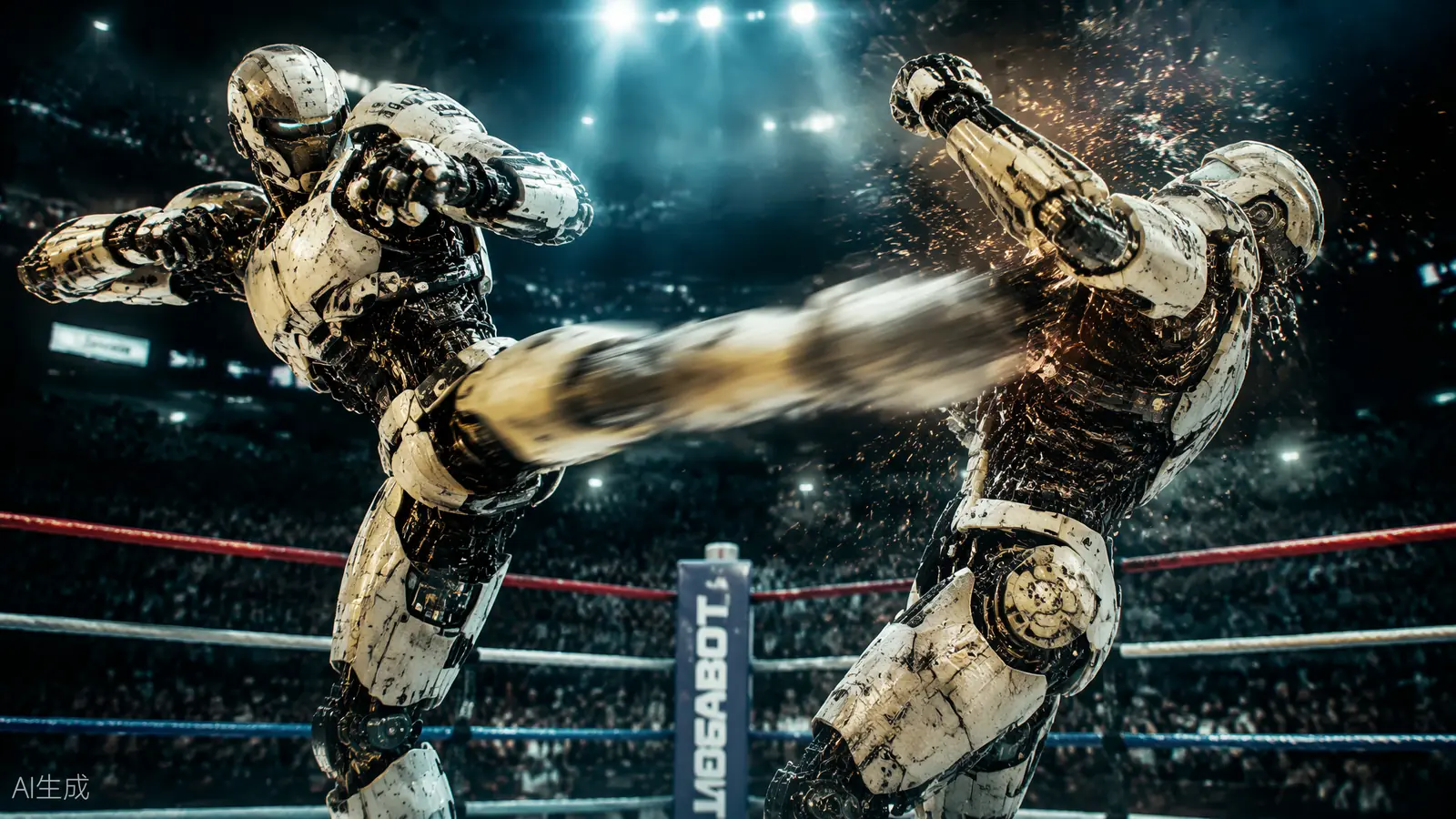
You have seen the clips: a humanoid robot the size of an adult throws a spinning kick, the other one hits the floor — and then, impossibly, stands back up. It looks like chaos. It is not. A robot fight has a shape, a rhythm and a logic, and once you see them, you will never watch the same way again.
This guide is part of our beginner's guide to robot fighting, the starting point for new fans. Here we decode a single bout from walkout to decision — the rounds, the knockdowns, the judging. It uses URKL, the first full-size humanoid league, as the reference, since that is where the sport is being defined right now; if you want the league itself explained first, read what URKL is, and for the fine print, our fan breakdown of the URKL rules.
The setup: two robots, one ring
A humanoid robot fight is built on a deliberate simplification: one ring, two machines, no weapons, no wheels, no human inside the ropes. In URKL the equality goes further — both competitors are the same EngineAI T800, a full-size humanoid roughly 173 cm tall, prepared by two different teams.
That single decision shapes everything you watch. There is no hardware arms race to understand. The visible differences between the two fighters — one wrapped in team-designed armor, the other leaner; one patient and upright, the other explosive — are choices, and every choice has a cost. Armor adds protection but weight and heat; aggression wins exchanges but risks balance.
Before the bout, officials check both machines, teams make final preparations in their corners, and the robots are set facing each other. From there, the format mirrors striking sports: timed rounds, corner work between them, judges at ringside.
The rhythm of a round
Watch any exchange closely and a pattern emerges. A robot fight is not continuous brawling — it breathes, in loops of three beats:
- Approach and range. The robots close distance and find their stance. This looks slow only if you miss what is happening: each machine is constantly solving balance, and every step is a calculation.
- The exchange. Punches, kicks, sometimes spectacular spinning techniques — the T800 platform is capable of side kicks and full aerial rotations. Clean connections matter; wild swings that leave a robot overextended are how knockdowns happen.
- The reset. After contact, both fighters re-stabilize. This is the tell-tale moment: the robot that recovers its base faster owns the next exchange.
Once you can see that loop — approach, exchange, reset — you are no longer watching chaos. You are reading the fight.
Knockdowns: the drama and the data
The knockout blow gets the views, but the knockdown is where robot fighting becomes its own sport. When a human boxer falls, the question is concussion and count. When a humanoid falls, the question is engineering: can it get up, and how fast?
Getting a 75-plus-kilogram humanoid from flat on its back to a fighting stance is one of the hardest problems in robotics. Teams that solve it turn a near-disaster into a scored demonstration of resilience. Teams that do not lose by stoppage. That is why recovery speed has become the sport's most-watched metric — a theme our analysis coverage returns to as the season's tactical picture develops.
A fall is also a judging signal even when the robot rises: it is recorded as a failure of stability and usually as the payoff of an opponent's effective strike. Nothing in the ring is free.
How the winner is decided
A bout resolves in one of two ways:
Stoppage — the robot-fight knockout. One machine can no longer meaningfully continue: down and unable to rise, or too damaged to defend itself. Officials can end the bout immediately, because there is no athlete's health to protect — only a pointless continuation to avoid. The other team wins on the spot.
Decision — the judges' scorecards. Both robots still functional at the final bell? The judges decide, scoring the criteria reported from URKL's opening night:
- Effective strikes — clean, connected offense, not volume.
- Body stability — staying upright and balanced under fire.
- Defensive and evasive ability — guard, footwork, slipping shots.
- Overall durability — still performing at full capacity late in the fight.
In practice, most decisions come down to a simple feel: which robot looked like it was winning the fight, and which one looked like it was surviving it? Judges are formalizing exactly that intuition.
Why the same robot makes it watchable
A quick note for the engineers in the room — and safe to skip if you are not one. The deep details of the T800's torque, sensors and control loops belong to technical coverage elsewhere; the fan-level point is this: identical hardware means every fight is a fair experiment. When one robot outfights another, the difference is software, preparation and strategy. You are watching two philosophies of robot combat collide, and the ring tells you which one was right. That is what makes how URKL fights are won a genuine tactical question rather than an engineering budget contest.
What happens next
You now have everything needed to watch a full bout intelligently: the three-beat rhythm, the meaning of a knockdown, the four judging criteria, and the two ways a fight ends. The natural next step is the sport's law book — our URKL rules explained for fans — and the league-wide picture in what is URKL.
Then pick a fight, watch it twice: once for the spectacle, once for the pattern. By the second viewing, you will be the person explaining the sport to everyone else in the room.