 RobotBoxe
This safety explainer is part of our robot fighting guides; readers new to the league can start with What is URKL?.
Why safety deserves a serious answer
A full-size humanoid is not a lightweight toy. EngineAI lists the T800 at 75–85 kg, depending on configuration, with powerful joint actuators and dynamic punching, kicking and recovery movements.
Risk can come from more than a deliberate strike:
- an unexpected fall;
- a limb moving during recovery;
- a robot losing its planned trajectory;
- a damaged component or detached cover;
- a person entering the arena during active motion;
- a battery, motor or electronic fault;
- an unsafe modification.
The purpose of event safety is to reduce the probability and severity of these situations. No cage or rule can promise zero risk. Our guide to why robot boxers fall explains the balance and impact mechanisms behind one of the most visible risks.
Safeguard 1: an enclosed arena
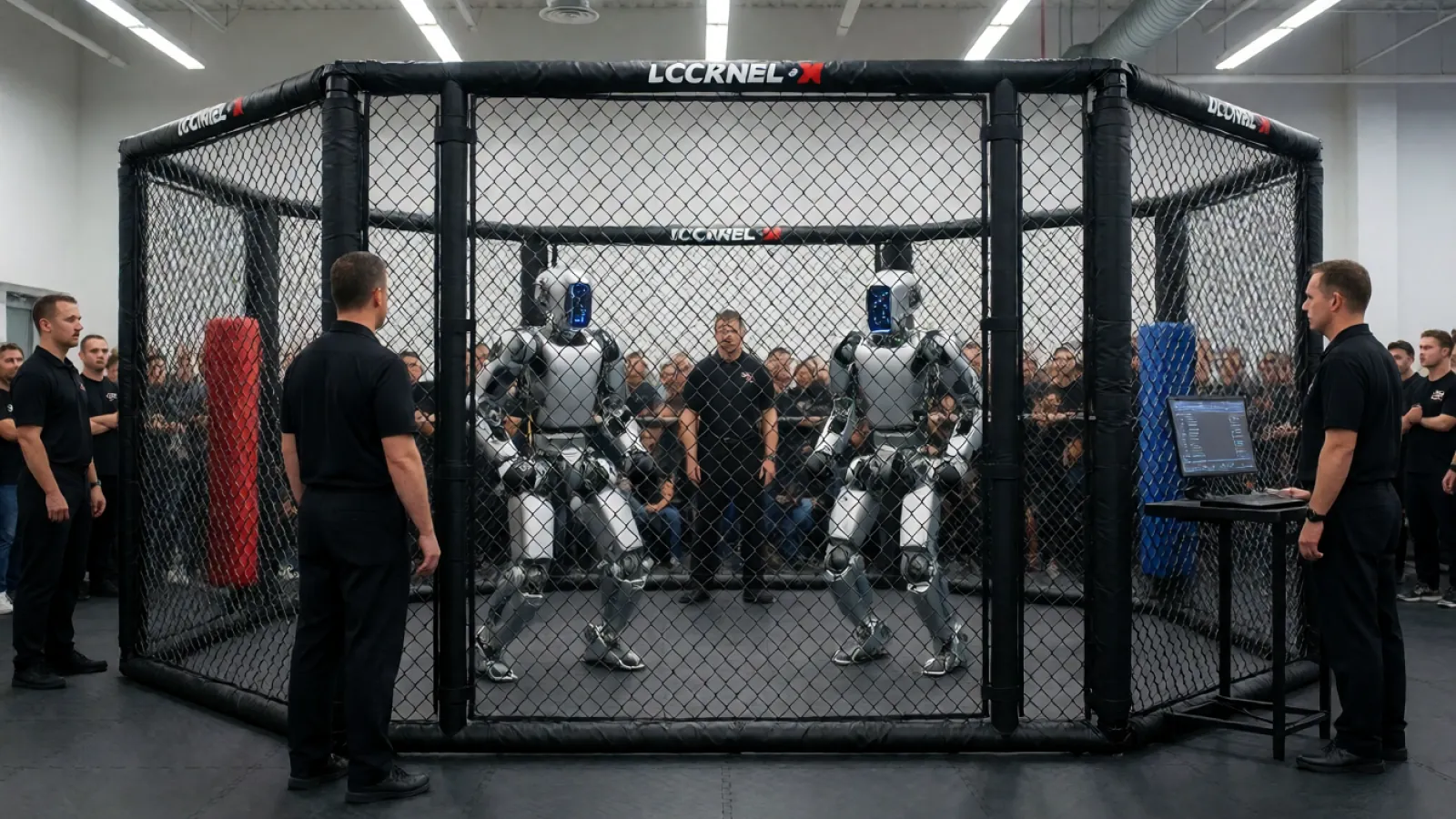
Section 8 of URKL’s V2.0.0 rules describes an octagonal cage with an eight-metre inscribed-circle diameter and iron fencing 1.9 metres high.
The cage creates a physical boundary between the robots and people outside the fighting area. It also defines where referees, teams and robots are expected to be during different phases.
For spectators, the practical lesson is simple: barriers and restricted zones are part of the safety system. Leaning through fencing, crossing a marked boundary or entering a team-only area can defeat protections that are otherwise visible.
The published rulebook’s cage specification does not replace each venue’s complete crowd-management plan. Seating distance, emergency routes and local instructions still matter.
Safeguard 2: padded, non-slip flooring
The same section requires non-slip combat-sports matting at least 2.5 centimetres thick inside the cage.
Padding can help manage falls and provide a more suitable surface than bare structural flooring. Non-slip behavior also matters for foot contact and balance.
This does not make a 75–85 kg humanoid fall harmless, especially for anyone inside the arena. It is one layer in a larger system that includes distance, referee control and restricted entry.
Safeguard 3: pre-match robot inspections
URKL’s knockout-stage rules require teams to bring robots to a designated inspection area with Wi-Fi disabled. Inspection covers items including:
- exterior and hardware modifications;
- weight and dimensions;
- software programs intended for competition;
- approval of cosmetic or other permitted modifications.
Dangerous modifications are prohibited. Teams must submit their control-program package for review, and the organizer can secure robots for post-match software inspection.
Inspection is not merely ceremonial. It gives officials an opportunity to check that the machine and software entering the cage correspond to the registered competition configuration.
Safeguard 4: weapons and dangerous modifications are prohibited
URKL’s section 8 prohibits weapons and states that use of an undeclared weapon in the arena leads to immediate disqualification.
The broader championship description also rejects destructive or violent modifications and emphasizes protective equipment, algorithmic innovation and engineering optimization.
That is a major distinction from combat formats built around spinning blades or deliberate mechanical destruction. A humanoid still carries kinetic energy and can fall unpredictably, but the published URKL concept is not an unrestricted weapons contest.
Special exhibitions or other organizers’ events should be checked against their own rules rather than assumed to inherit every URKL provision.
Safeguard 5: referee-controlled stops and neutral corners
A knockdown triggers a defined procedure. The referee begins a 30-second count, and the attacking robot must retreat to a neutral corner and stop attacking.
If the downed robot cannot resume, the technical-timeout process allows the team to attempt repairs or an eligible replacement under controlled conditions. The opposing team may not operate its robot during the suspension.
These rules reduce the chance of continued attacks while people are addressing a downed machine. They also make entry into the arena a formal, referee-controlled event rather than an invitation for staff to rush toward moving robots.
Safeguard 6: restricted equipment and entry during repairs
During a technical timeout or knockdown suspension, team members may bring only a toolbox into the arena. Lifting rigs are prohibited under section 8.
Team members otherwise face restrictions on bringing computers, mobile phones and electronic devices into the competition area. Robot replacement must involve one of the team’s pre-registered machines and follow the referee’s procedure.
These provisions limit uncontrolled activity around the robots. They also show why spectators should never interpret a paused fight as permission to approach the cage or help staff.
Safeguard 7: manufacturer distance warnings
EngineAI’s official T800 page includes a direct warning: because of the robot’s complex structure and extremely powerful actuators, users must maintain a safe distance and exercise extreme caution during operation.
Unitree publishes a similar general warning for its G1 humanoid. These warnings reinforce an important point: the robot does not need malicious intent or full autonomy to be dangerous. A commanded movement, recovery action or fault can create risk.
The manufacturer warning is especially relevant for demonstrations outside a formal match. A close-up fan interaction should not be assumed safe merely because the robot appears stationary.
What spectators should check before attending
A public event listing may not reproduce the entire safety plan. Visitors can still make sensible checks:
- Use official ticketing and venue information. Confirm the event, entrance and age restrictions where published.
- Stay within assigned spectator areas. Do not move barriers or enter team routes.
- Follow staff instructions during pauses and evacuations. A technical stoppage is not an open invitation to approach.
- Keep hands and objects away from fencing. Robots and components can move close to the boundary.
- Supervise children closely. Excitement and curiosity can make restricted edges tempting.
- Do not assume a robot is powered down. Only authorized staff should decide when it is safe to approach.
- Check event-specific rules. A fan zone, exhibition and championship match may have different operating procedures.
These are general precautions, not a substitute for the venue’s own safety instructions.
What fight teams still have to manage
Teams and staff work closer to the machines, so their exposure is different from that of spectators. Their procedures must account for activation, transport, testing, repairs and unexpected movement—not just the official rounds.
Useful operational questions include:
- Who has authority to stop the robot?
- How is the machine made safe before people approach?
- How are batteries and damaged components handled?
- Which tools and replacement parts are permitted?
- How are staff protected during a recovery attempt?
- What happens if a robot behaves unexpectedly outside the cage?
The public rulebook does not answer every operational detail. A complete safety assessment therefore requires the organizer’s venue procedures and risk controls, not only the scoring document.
Does autonomous control make robot boxing less safe?
Autonomy changes who selects actions, but it does not automatically make an event safer or more dangerous. Risk depends on action limits, supervision, testing, emergency stopping, arena control and how the system handles unexpected states.
A remote-controlled robot can still fall or move unpredictably. An autonomous robot can still operate within strict limits and independent safety controls.
The better question is whether the organizer can explain the robot’s operating envelope and stop procedures for that event. The single label “AI-controlled” provides little safety information by itself.
Our guide to how robot fighting works explains the difference between tactical control, automatic balance and supervision.
So, is robot boxing safe?
The most honest answer is managed risk, not zero risk.
URKL documents meaningful protections: a cage, matting, inspections, weapon restrictions, referee-controlled pauses and limited repair access. Manufacturers also make clear that full-size humanoids require distance and caution.
For spectators, safe attendance depends on those controls plus venue crowd management and compliance with instructions. For teams, it requires disciplined technical procedures around powerful, unpredictable physical systems.
Robot boxing is safer to watch from the designated audience area than to treat as a close-contact demonstration—and no viral clip should convince viewers otherwise. For an introduction to rounds, scoring and knockdowns, read our beginner’s guide to robot fighting.