 RobotBoxe
This explainer is part of our robot fighting guides.
Standing still is easier than fighting
A humanoid can look stable during a slow demonstration and still struggle in a bout. Fighting combines several disturbances at once:
- the feet step and change position;
- the torso rotates;
- the arms or legs accelerate;
- the opponent applies unexpected force;
- the floor contact changes during slips or collisions;
- damaged or hot components may respond differently.
Balance is therefore not a fixed pose. It is a continuous control problem in which the robot estimates its state and adjusts movement before a small disturbance becomes a fall.
Reason 1: a humanoid has a high center of mass
A full-size humanoid carries much of its structure, computing and power system above the floor. Its support comes through relatively small feet rather than a broad fixed base.
When the body’s motion and support conditions remain within a recoverable range, the controller can correct. When an impact or movement pushes the system beyond that range, the robot may need a rapid step, an arm action or another recovery response.
If that response is too late, poorly placed or physically blocked, the fall continues.
The exact balance criterion depends on motion. A static explanation based only on keeping the center of mass directly above the feet is not enough for running, kicking or collisions.
Reason 2: every strike moves more than the fist
A punch is a whole-body event. The arm accelerates, the torso may rotate, the legs adjust and the floor supplies reaction forces.
The same action that sends the fist forward can disturb the rest of the body. A stronger or faster movement is not automatically better if it leaves the robot unable to control the recovery phase.
Teams must coordinate:
- preparation and guard;
- weight transfer;
- arm or leg acceleration;
- contact or a miss;
- return to a stable fighting stance.
A miss can be as challenging as a hit. The robot may have prepared for contact that never arrives, leaving momentum to manage with no opposing force at the expected moment.
Reason 3: kicks temporarily remove support
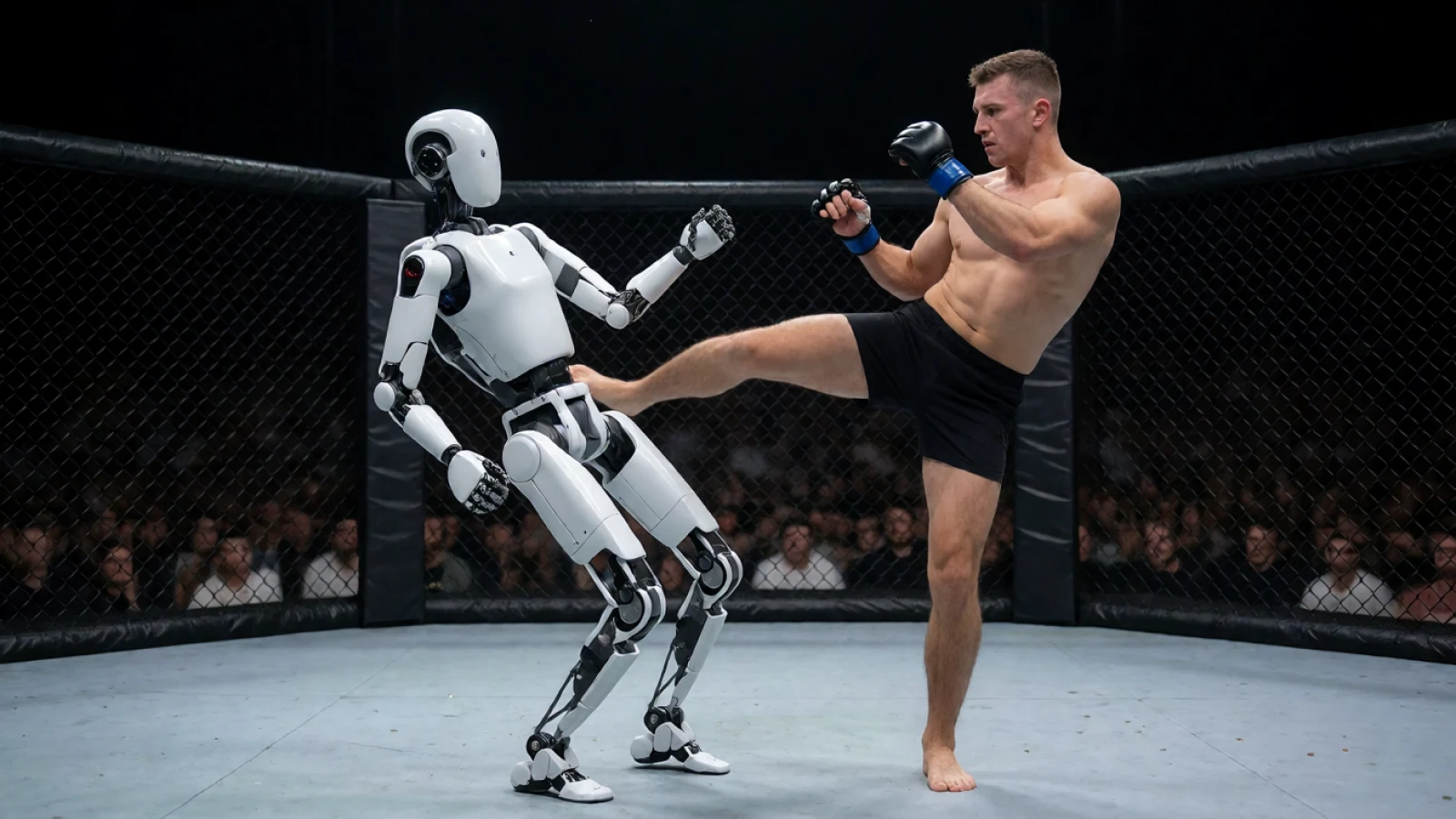
During a kick, one leg becomes the striking limb while the other supports the body. The support area changes, the body rotates and the raised leg carries momentum away from its normal role in balance.
The landing is another critical transition. The robot must bring the foot back under control, absorb contact with the floor and return to a stance that can respond to the opponent.
More dynamic techniques add difficulty. A flying knee introduces an airborne phase, which means the robot cannot make ordinary foot-contact corrections until landing. That is one reason URKL’s Shanghai flying-knee demonstration attracted attention.
Our Shanghai moves guide explains the kip-up, curved footwork and flying knee in viewer-friendly terms.
Reason 4: impacts arrive outside the plan
A robot may have a stable plan for its own strike but not for the opponent’s simultaneous movement. Contact can arrive at an unexpected height, angle or time.
The controller then has to answer several questions quickly:
- How much did the body state change?
- Is the current foot placement still usable?
- Can a corrective step restore balance?
- Is a limb making contact with the opponent or floor?
- Should the system attempt recovery or manage the fall?
Sensors and estimation are not perfect. Occlusion, vibration, contact and delays can make the true state harder to determine than a clean overhead replay suggests.
Reason 5: recovery actions can themselves fail
Getting up is not one simple movement. The robot may land face-down, face-up, on a side, against another robot or near the cage. Each configuration offers different contacts and joint limits.
A recovery policy has to find a feasible sequence without demanding torque or joint positions the hardware cannot safely deliver. It also has to finish in a state where ordinary balance control can take over again.
URKL’s qualification rules test prone and supine recovery separately, with faster autonomous recovery earning more points. That reflects the competitive importance of getting up, not merely avoiding the floor.
Reason 6: hardware condition changes during a fight
A robot’s behavior can change as components heat, batteries discharge, connections loosen or protective parts shift. A strike that worked in testing may behave differently after repeated impacts.
Mechanical damage can also change the geometry the controller expects. If a sensor, cover or joint no longer matches its normal state, the control system may be working with a degraded machine.
Technical timeouts and inspections therefore matter. They allow teams to address faults, but they do not guarantee that every problem can be repaired within the allowed window.
Is falling a sign of bad robotics?
Not necessarily by itself. A fall can indicate a weakness, but it can also reveal that the robot attempted a more dynamic action or encountered a genuine disturbance.
IEEE Spectrum’s discussion with humanoid developers makes a related point: robots should be designed to fall, mitigate damage and recover. Agility Robotics’ Jonathan Hurst described arms as useful for absorbing falls, while Boston Dynamics’ Aaron Saunders discussed control layers for catching a fall and reducing harm when it cannot be prevented.
The better evaluation asks:
- How often does the robot fall under the same test?
- What caused the loss of balance?
- Did it manage the impact safely?
- Could it recover without assistance?
- Did the same fault repeat?
A robot that never attempts difficult contact may fall less while demonstrating less useful capability. These questions also matter for spectator and team safety.
Does a fall mean the match was scripted?
No. A real physical system can lose balance whether its tactical actions are human-controlled or autonomous. Our guide to how robot fighting works explains why both modes still depend on automatic stabilization. A genuine fall does not prove a predetermined winner, and a planned demonstration does not require every slip to be fake.
Editing can still change what viewers understand. A short clip may remove the cause, the recovery or earlier failed attempts. It is best to judge the complete available sequence rather than an isolated impact.
For the scoring context around a knockdown, read how URKL fights are won.
Knockdown and KO are not the same thing
Under section 8 of URKL’s V2.0.0 rules, a robot is considered down when any body part other than the soles of both feet touches the floor. The referee starts a 30-second count.
If the robot stands unassisted and resumes a fighting stance before the count ends, competition continues. If not, the team’s three-minute technical-timeout process begins. A KO requires that the team have no robot capable of continuing under the rule’s conditions.
That means a fall can be a temporary interruption rather than the end of the match. Recovery is part of the contest. Our beginner’s guide to robot fighting explains how to watch that sequence.
Why getting up can be more impressive than not falling
Audiences naturally celebrate a knockout-style fall, but reliable recovery may reveal more about a humanoid’s practical robustness.
A strong recovery demonstrates:
- body-state awareness after an unusual landing;
- coordinated use of arms, legs and torso;
- enough actuator capability to change posture;
- transitions between different control phases;
- a return to stable locomotion or fighting stance.
Shanghai’s kip-up was striking because it compressed that process into an explosive whole-body action. It should still be evaluated through repeated, event-specific evidence rather than one viral replay.
For the deeper control explanation, read how humanoid robots balance on our technical sister site.