 RobotBoxe
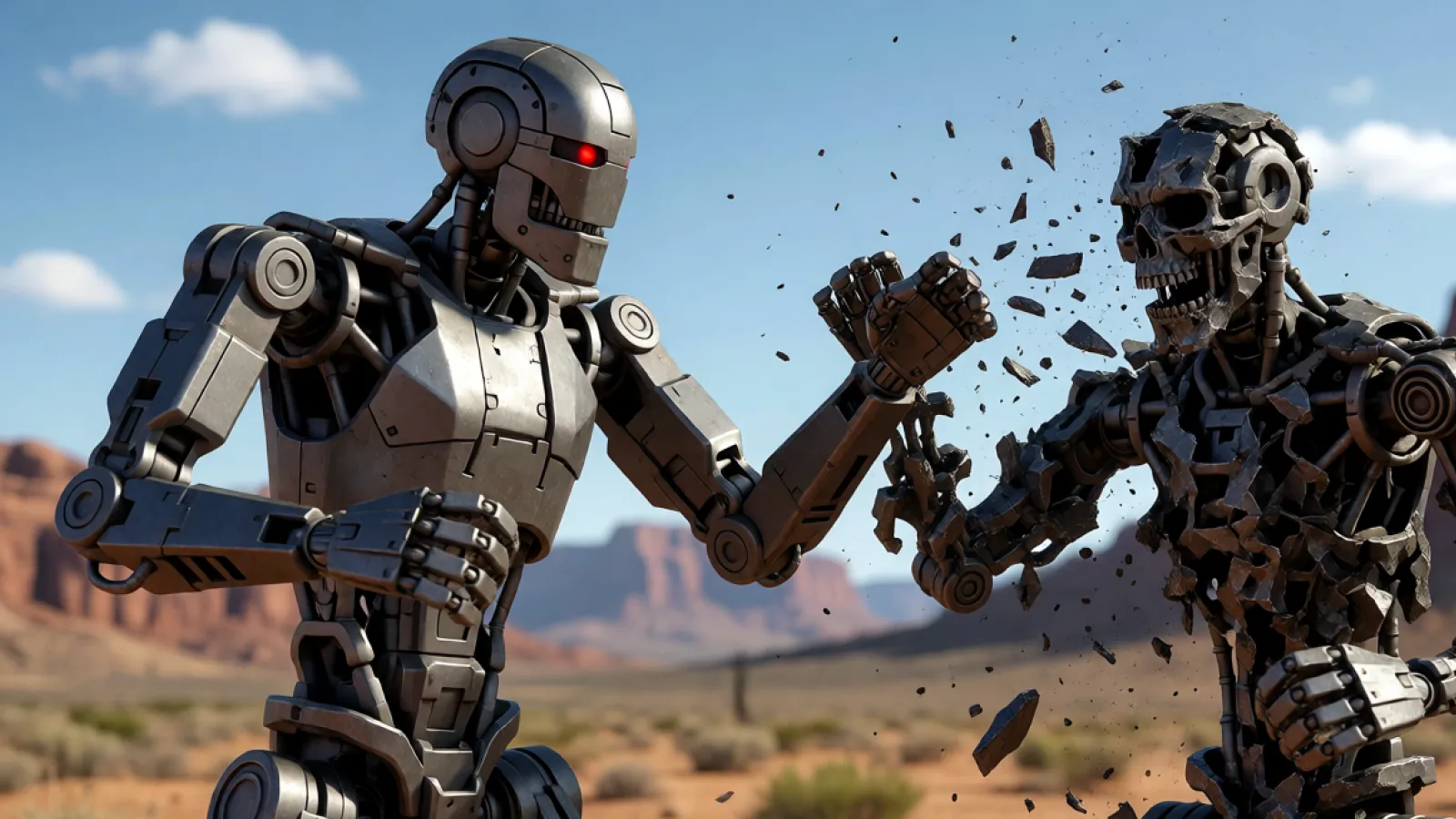
This beginner-friendly comparison is part of our robot fighting analysis.
The shortest comparison
| Question | URKL | BattleBots | UFC |
|---|---|---|---|
| Who or what competes? | Full-size humanoid robots, led by the T800 platform | Custom-built combat machines | Human professional MMA athletes |
| What does the fighter look like? | Two arms, two legs and a torso | Usually wheeled machines built around armor and a weapon | A person competing in a regulated weight class |
| What are the “weapons”? | The robot’s limbs and body movements | Dedicated powered spinners, flippers, hammers, grabbers and other designs | Punches, kicks, knees, elbows and grappling techniques |
| Who controls the action? | Event-dependent robot software and human supervision; Shanghai organizers claimed fully autonomous fighting | Reliable remote control is required, with autonomous functions allowed only if they can be remotely disabled or overridden under the 2021 design rules | Athletes make their own decisions within the rules and referee’s authority |
| Is the hardware standardized? | URKL’s championship format uses a shared T800 platform | Teams design substantially different machines within safety and design limits | No machine hardware; athletes use regulated equipment |
| What does a fall mean? | A stability failure, possible damage and a recovery problem | A loss of mobility or position, often depending on whether the machine can self-right | A knockdown, knockback or grappling situation depending on the exchange |
| What is damaged or injured? | Mechanical, electrical and structural components | Mechanical and electrical systems, often including weapons and armor | Human bodies, creating medical and long-term health concerns |
| Typical way to win | Event-specific stoppage or scoring; published event results should be followed | Disable the opponent or win under the event’s judging rules | Knockout, technical knockout, submission, decision or other official result |
The BattleBots examples in this article use its 2021 Design Rules, which are a documented historical reference—not a claim about every detail of a 2026 rulebook. URKL’s public rules and event formats are also still developing, so exact scoring should be checked for each event.
UFC: human athletes in a broad fighting sport
The Ultimate Fighting Championship promotes mixed martial arts contests between human athletes. Competitors can strike and grapple, subject to a detailed ruleset, referee supervision and medical oversight.
The UFC’s Unified Rules prohibit actions including eye gouging, biting, groin attacks, strikes to the back of the head and attacks after the bell. Those rules exist because the central safety problem is human injury.
Victory can come through several routes, including a knockout, submission or judges’ decision. A fighter’s conditioning, pain tolerance, technique and tactical judgment all matter. The athlete is both the competitor and the physical system at risk.
That is the deepest difference from robot fighting: a damaged robot can be repaired, while an injured athlete may carry consequences far beyond the event.
BattleBots: engineering machines around destructive weapons
BattleBots places custom machines inside a protected arena. Its designs are often low and wheeled because the objective is not to imitate a person. It is to weapon, armor and drive system as effectively as possible within the rules.
The 2021 Design Rules required reliable remote control over all bot functions and positions. Autonomous functions were acceptable if the operator could remotely disable or override them. The same document required at least one independently powered weapon capable of seriously affecting another bot.
This creates a different design contest from URKL. A BattleBots team might optimize a spinning bar, armor, drive traction and self-righting. It does not need to solve bipedal walking or coordinate a human-sized body through a punch.
The 2021 document set a 250-pound maximum for standard bots ready to fight, with separate provisions for flying robots, walkers and other configurations. Those figures belong to that revision and should not be generalized automatically to later seasons.
URKL: humanoid movement becomes the contest
URKL uses human-shaped machines that enter a ring and fight through body movements. The result resembles striking-based combat sports more than a conventional robot-weapon contest.
The league’s championship concept uses EngineAI’s T800 as a shared platform. That makes software, preparation, movement strategy and adaptation especially important, because teams are not simply arriving with completely unrelated chassis and weapons.
The fan’s attention also shifts. In BattleBots, a destroyed wheel or disabled spinner may decide the action. In URKL, a fighter’s stance, recovery and ability to continue after contact become central. A robot that falls but quickly gets up can remain part of the contest.
For a round-by-round fan introduction, see how robot fighting works. For the league’s background and shared-platform concept, read What is URKL?.
Humanoid punches versus powered weapons
This is the clearest practical distinction.
A URKL robot strikes with its own body. To land a kick, it must support itself through the movement, manage momentum and recover afterward. The attack and the balance problem are inseparable.
A BattleBots weapon can be designed specifically for destruction. A spinner does not need to resemble an arm, and the machine can be shaped around storing and delivering energy. Mobility and weapon power are related, but they are not constrained by a human body plan.
A UFC athlete also strikes with the body, but combines that with grappling, submissions and trained defensive reactions. Unlike a robot, the athlete can improvise through pain, fatigue and rapidly changing sensory information.
These differences make direct “who would win?” comparisons mostly meaningless. Each format rewards a different kind of system and operates under different safety constraints.
Remote control, autonomy and human judgment
Control is often the most misunderstood part of the comparison.
UFC
The athlete makes the fighting decisions directly. Coaches can advise from outside, and the referee enforces the rules, but nobody remotely operates the competitor.
BattleBots
Human operators drive the machine and command its weapon. The 2021 rules allowed autonomous functions only with remote disable or override capability. Watching BattleBots therefore means watching both machine design and operator skill.
URKL
The public picture is more complicated. A humanoid fight may involve trained movement skills, software selecting those skills, human supervision and safety intervention. Shanghai’s organizers described fully autonomous fighting in September 2026, but edited footage cannot independently establish every control mode throughout the event.
It is therefore inaccurate to label every URKL fight either a simple remote-controlled puppet show or a completely independent robot contest. The event’s published control rules and the organizer’s specific claims need to be examined separately.
Standard hardware versus custom engineering
URKL and BattleBots sit at opposite ends of a useful design spectrum.
With a shared robot platform, URKL can make team differences easier to interpret. If the machines begin with the same fundamental body and actuators, movement quality, software and preparation become more visible.
BattleBots deliberately invites radically different solutions. A flipper, vertical spinner and control-focused grabber can all enter the same competitive environment. The design itself is a major part of the spectacle.
UFC has no equivalent hardware division. Athletes have different bodies and training backgrounds, but the contest is regulated through weight classes, equipment rules and a common prohibited-actions framework.
Knockouts, stoppages and decisions
All three formats can produce a decisive ending or a judged result, but the meaning is different.
- UFC: a knockout or submission involves a human athlete’s inability or failure to continue under the rules. Medical considerations are central.
- BattleBots: a knockout generally means the machine cannot continue or move as required. The team may repair it for a later match.
- URKL: a stoppage can reflect a robot’s inability to rise, move or continue effectively, while decisions depend on the published rules for that event.
URKL’s opening White Eagle–Matador fight showed why fans need the actual score rather than only the final highlight. White Eagle produced the spectacular late damage, but Matador won the published 3–2 decision. A dramatic moment does not automatically settle a multi-round contest.
Damage is not the same as injury
Robot fighting can be destructive without involving pain or consciousness. That changes both ethics and production.
Teams can replace a damaged component, inspect a battery or rebuild a mechanism. The costs are financial, technical and competitive. In human fighting, damage is suffered by a person, and the referee and medical staff must protect athlete welfare.
This does not mean robot events are risk-free. Heavy moving machines, batteries and high-energy weapons require arena design and operational safety. It means the primary concern is protecting people around the machines rather than protecting the machines as feeling participants.
Which format is best for a new fan?
Choose UFC if you want human technique, athletic narratives, grappling and a mature championship structure.
Choose BattleBots if you enjoy visible mechanical destruction, radically different engineering designs and the partnership between builders and operators.
Choose URKL if the appeal is seeing whether humanoid robots can turn balance, movement and recovery into a watchable new combat sport.
URKL is closer to the UFC in presentation and closer to BattleBots in hardware, but it is not simply a mixture of the two. Its defining problem is unique: making a bipedal machine fight through the same body it uses to stay upright.
For another comparison focused on fiction rather than other sports, read Real Steel versus URKL.