 RobotBoxe
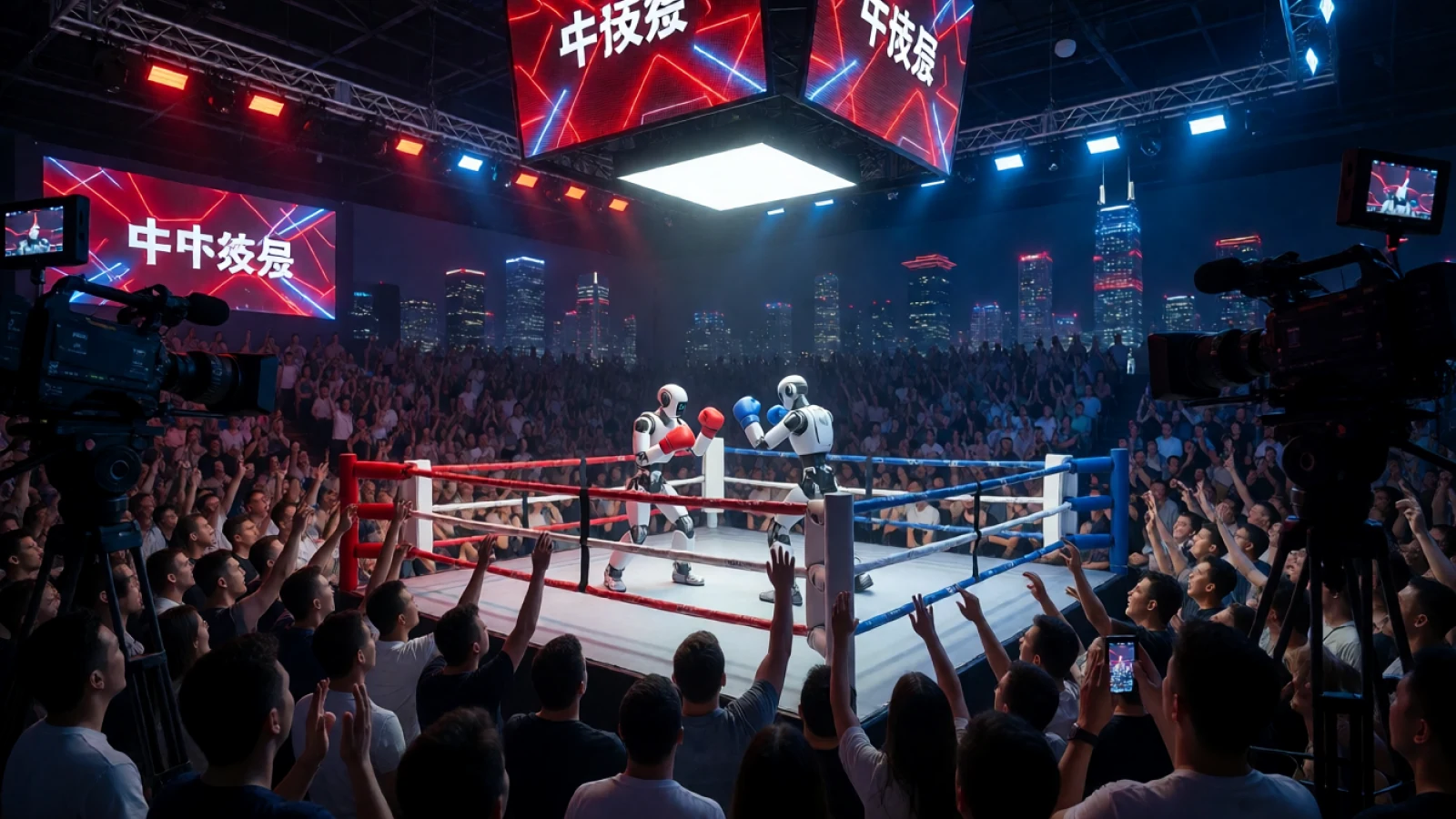
This article is part of our robot fighting analysis.
It makes humanoid progress visible to everyone
Many robotics benchmarks are difficult for a general audience to interpret. A better calibration routine, a cleaner state estimate or a more robust control policy may be important without producing an obvious visual story.
Robot boxing compresses those challenges into simple questions:
- Can the machine stay upright?
- Can it find and approach an opponent?
- Can it throw a strike without losing balance?
- Can it absorb a disturbance?
- Can it get back up?
A viewer does not need to understand joint control to recognize a successful recovery. That makes the ring an unusually clear public interface between advanced engineering and mainstream attention.
It is a stress test, not just a show
A clean stage demonstration often controls the route, lighting, timing and contact. A fight introduces an opponent, unpredictable spacing and physical impacts.
Those conditions test several systems at once:
- Perception: locating and tracking another moving humanoid.
- Decision-making: choosing when to approach, retreat, strike or recover.
- Balance control: coordinating the whole body while support and momentum change.
- Hardware durability: surviving repeated contact, falls and repairs.
- Operations: managing batteries, timeouts, inspections and resets under event pressure.
A single dramatic punch does not prove general-purpose intelligence. But repeated physical events can generate useful evidence about reliability in a less controlled setting.
A standard robot turns the contest into an engineering comparison
URKL uses EngineAI’s T800 as its standard competition platform. That choice reduces the temptation to interpret every result as a simple hardware spending contest.
The official framework emphasizes differences in algorithms, parameter tuning, protection and engineering optimization. Teams can work on control policies and deployment rather than arriving with entirely unrelated machines.
This is attractive for a developing ecosystem because it creates:
- a shared technical target;
- comparable test conditions;
- reusable simulation and deployment tools;
- a common vocabulary for evaluating progress;
- a reason for universities, companies and research teams to participate.
Standardization does not remove every hardware difference or guarantee fairness in practice. It does make the competition easier to organize and understand.
The format creates a talent pipeline
The Nanshan government reported that more than 200 teams from China, the United States, Poland and Singapore initially registered, with 32 advancing after qualifying. The published rules also connect top-eight participation with an EngineAI recruitment fast track.
That links entertainment to a concrete technical labor market. A team’s work can demonstrate abilities in simulation, motion data, real-robot deployment and robust control—skills relevant beyond boxing.
The ring therefore functions partly as a portfolio. Instead of presenting only a paper or a polished video, participants can show how their system behaves under contact, time pressure and failure.
A recruitment fast track is not a guaranteed job, but it reinforces the competition’s role as a talent-discovery mechanism.
Live events give host cities a technology story
Shenzhen and Shanghai offer different examples of the same strategy.
Shenzhen: launch a recognizable competition property
The July opening placed EngineAI, the T800 and URKL in front of a live audience. Fighter identities such as White Eagle and Bullfighter gave viewers an easy way to follow the action.
Public presentations and fan-zone activity extended that visibility beyond a single arena session.
Shanghai: connect robotics with tourism and local industry
Jiefang Daily reported that 5,000 tickets for Shanghai’s two September sessions sold out. The event was also included in Shanghai Tourism Festival programming, according to the city’s official recap.
That combination lets a host city present robotics as culture and entertainment, not only as manufacturing policy. Local partners can connect the show with training, industrial projects, venues and future visitor experiences.
The sellout demonstrates demand for that particular event. It does not establish a guaranteed audience for every future stop.
It turns technical branding into entertainment IP
A humanoid specification sheet rarely creates a fan. A named fighter with recognizable armor and a documented rivalry can.
URKL’s presentation borrows useful techniques from combat sports and cinema:
- distinctive fighter names and colors;
- introductions and arena lighting;
- round-based action;
- replays and highlight clips;
- tour stops attached to particular cities.
This does not make the physical contest unreal. It means the engineering product is packaged in a form audiences can follow and remember.
The approach also creates more than one potential revenue or partnership path: tickets, sponsorship, local promotion, media distribution, merchandise and technology showcasing. Public sources do not yet establish the actual contribution or profitability of each path, so they should be treated as possibilities rather than audited business results.
Why China has the right ingredients for the format
The format benefits from the coexistence of humanoid manufacturers, engineering teams, electronics supply chains, large venues and local partners interested in technology-led events.
Shenzhen provides the company and hardware base. Shanghai’s event shows how that base can connect with another city’s tourism, venue and robotics-industry resources.
The important point is not that robot boxing is uniquely Chinese. It is that Chinese organizers have moved quickly to combine these ingredients into repeatable public events.
Other countries can and do host robot competitions. URKL’s distinction is its use of full-size humanoids, standardized T800 hardware and a commercial event identity.
What robot boxing does not prove
The excitement can encourage exaggerated conclusions. A fight does not, by itself, prove:
- that the winning robot is ready for factory or household work;
- that every movement was autonomous;
- that a single hit measures total platform quality;
- that all tour events use championship rules;
- that the entire business model is profitable;
- that a highlight reel represents every failed attempt.
These limits make the events more informative, not less. They help viewers separate a specific physical achievement from a broad marketing claim.
Our guide to how robot fighting works explains the physical contest and control methods behind the spectacle.
The Real Steel effect helps—but reality is the main story
The film gives audiences an instant reference point. Searching “Real Steel in China” is often a way of asking whether cinematic robot boxing has become real.
The answer is that physical humanoid combat now exists, but its rhythm and limitations are different. Current robots can be slower, less predictable and more vulnerable to balance failures than their movie counterparts.
Those imperfections are part of the appeal. Viewers are not only watching a finished illusion; they are watching a technology improve in public.
For the direct comparison, read Real Steel vs. URKL. For the league’s identity, see what URKL stands for. For the mechanics behind the visible setbacks, read why robot boxers fall.